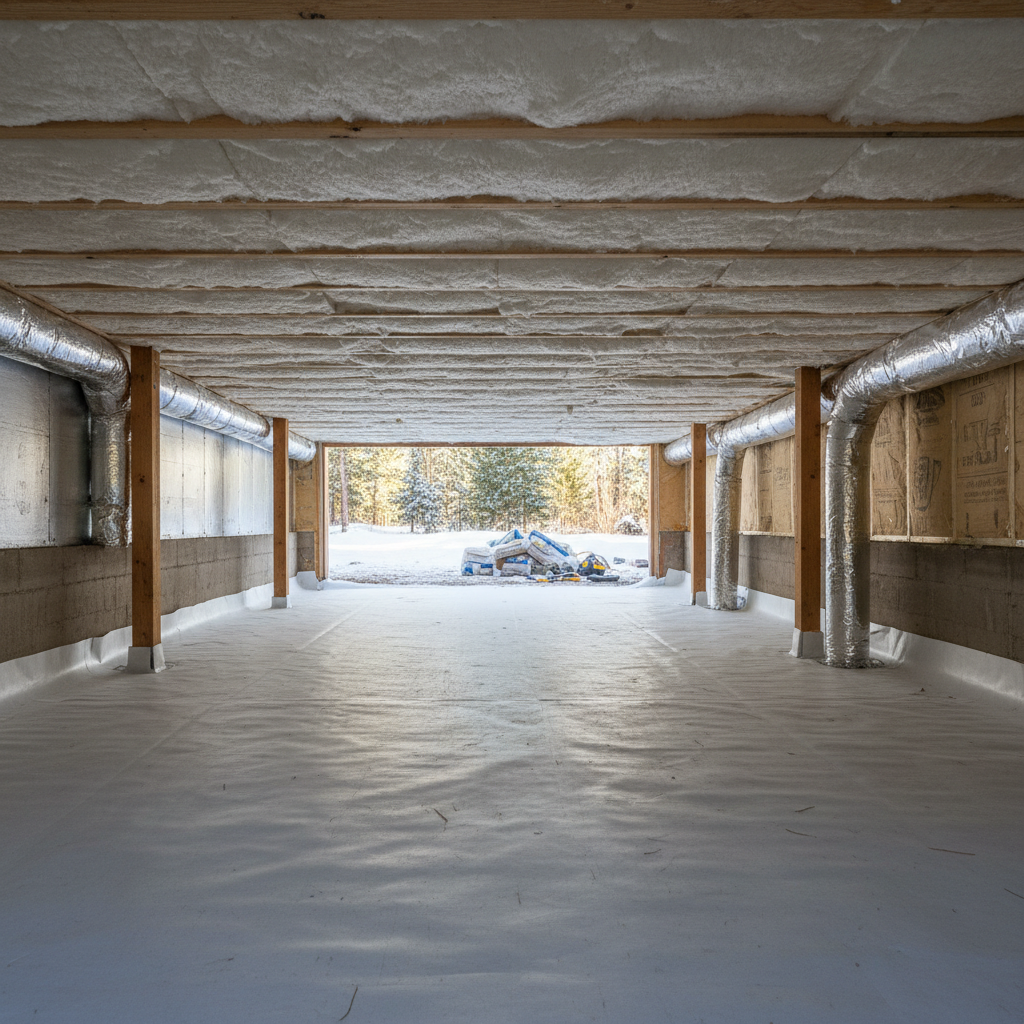
Let's actually talk about what it costs to insulate a crawl space here in McCall. People ask me this constantly, and honestly, there's a ton of vague information out there. I'm not here to give you some fluffy sales pitch. Instead, I'm just going to lay out what I see on the job site and what you should really expect.
What Makes the Price Go Up or Down?
A few big things really move the needle on price when you're looking at crawl space insulation. It's not just about the square footage, though that's certainly a big piece of the puzzle.
- Insulation Type: This is probably the biggest factor, wouldn't you say? You've got your basic fiberglass batts, rock wool, rigid foam boards, and then spray foam. Each one costs differently per square foot, and they all perform differently too, especially in our climate. Fiberglass batts are the cheapest upfront, sure, but they don't handle moisture well. That's a real concern in McCall, what with our heavy snowmelt and sometimes damp crawl spaces. Rigid foam or closed-cell spray foam cost more initially, but they offer much better moisture resistance and R-value for their thickness.
- Crawl Space Condition: Is it clean and dry down there? Or is it more like a swampy mess, full of old, falling insulation, animal droppings, and standing water? If we have to do a major clean-out, yank out old insulation, or deal with mold remediation, that's definitely going to add to the labor and disposal costs. Access matters a lot too. If it's a tight, 18-inch crawl space under an older cabin up near Upper Payette Lake, it's just going to take more time and effort than a nice, tall, easy-to-access one.
- Vapor Barrier Needs: Most crawl spaces around here really need a good vapor barrier. If you don't have one, or if yours is torn and useless, we'll need to put in a new one. This isn't insulation, but it's absolutely crucial for keeping moisture out of your crawl space and protecting your actual insulation. A quality 10-mil or 12-mil vapor barrier adds to both the material and labor cost.
- Air Sealing: Before you even think about insulating, you really should air seal. We're talking about sealing up all those tiny gaps and cracks where cold air can sneak in or warm air can escape. Usually, we do this with expanding foam or caulk. It's a separate step, but it makes your insulation work a whole lot better. If a contractor doesn't even bring up air sealing, well, be wary.
- Ventilation/Encapsulation: Some McCall homes might really benefit from a full crawl space encapsulation, especially if moisture is a constant headache. This means sealing off vents, putting down a heavy-duty vapor barrier on the ground and up the walls, and often adding a dehumidifier. This is a much more complete solution, and it costs a lot more than just insulating.
Typical Cost Ranges in McCall
Alright, let's get down to some actual numbers. Remember, these are just averages for a typical 1,000 to 1,500 square foot crawl space. Your specific situation will definitely be different.
- Fiberglass Batts (Floor Joists): If you're just replacing old, falling batts with new ones, you might be looking at $1.50 - $2.50 per square foot. This is the cheapest option, but honestly, I don't recommend it for most McCall crawl spaces because of our moisture issues. It's really just a band-aid, not a solution.
- Rigid Foam Board (Walls/Rim Joists): For insulating crawl space walls and rim joists with rigid foam (like XPS or polyiso), you're generally in the $3.00 - $5.00 per square foot range. This is a much better option for dealing with moisture and improving thermal performance.
- Closed-Cell Spray Foam (Walls/Rim Joists): This is premium stuff, no doubt, and it performs incredibly well. For closed-cell spray foam on crawl space walls and rim joists, expect to pay anywhere from $6.00 - $10.00 per square foot. It's more expensive, yes, but it also acts as both an air barrier and a vapor barrier all in one. That's a solid investment for our climate.
- Vapor Barrier Installation: If you need a new 10-mil or 12-mil vapor barrier, plan on an additional $1.00 - $2.00 per square foot.
- Crawl Space Clean-Out/Prep: This is super variable. If it's just removing some old insulation, maybe $500 - $1,000. But if it's a full-on hazmat situation with animal waste and mold, that could easily run into several thousand dollars.
So, for a 1,200 sq ft crawl space, a basic rigid foam job with a new vapor barrier might run you $4,800 to $8,400. A full closed-cell spray foam job, including a clean-out, could easily hit $9,000 to $15,000 or even more. These aren't small numbers, but neither are your energy bills if your crawl space is letting all that cold air in, are they?
What Should a Quote Include?
When you get a quote from McCall Insulation or any other reputable company, it should be pretty detailed. Don't just accept a one-liner. You want to see:
- Scope of Work: Exactly what areas they're insulating (floor joists, walls, rim joists, etc.).
- Materials: The specific type of insulation (e.g., R-19 fiberglass batts, 2 inches of closed-cell spray foam, 2-inch XPS rigid foam).
- R-Value: What R-value they're aiming for.
- Prep Work: Any clean-out, old insulation removal, or air sealing that's part of the job.
- Vapor Barrier: If one's being installed, what mil thickness it is.
- Warranty: What kind of warranty comes with the work.
- Total Cost: A clear, itemized breakdown if possible, or at least a lump sum that covers everything.
Make sure they've actually been in your crawl space to see what's going on. A quote over the phone is almost useless, in my opinion.
How to Avoid Overpaying
It's pretty simple, really, but people still manage to mess it up.
- Get Multiple Quotes: Don't just go with the first guy who shows up. Get at least three detailed quotes. This helps you compare apples to apples and really understand the market rate for the work.
- Understand the Scope: Make sure each quote is for the same scope of work. If one guy is quoting fiberglass and another is quoting spray foam, you can't compare those prices directly, can you?
- Ask Questions: If you don't understand something, ask. A good contractor will take the time to explain it to you.
- Check References & Reviews: See what other folks in McCall say about them. Word of mouth is a big deal in a town like ours.
- Don't Chase the Lowest Price: The cheapest bid often means cut corners, inferior materials, or a crew that doesn't know what they're doing. You'll just end up paying more in the long run. Good insulation is an investment, not a place to skimp.
Your crawl space is a critical part of your home's energy envelope, especially with our long, cold winters. Getting it right means a warmer house, lower energy bills, and fewer moisture problems down the line. It's absolutely worth doing it right the first time.